The
term
Vodou
(Vodun
or
Vudun
in
Benin
and
Togo);
also
Vodon,
Vodoun,
Voudou,
or
other
phonetically
equivalent
spellings.
In
Haiti;
Vudu
(an
Ewe
word,
also
used
in
the
Dominican
Republic)
is
by
some
individuals
applied
to
the
branches
of
a
West
African
ancestral
religious
tradition,
or
to
individual
spirits
or
deities
within
that
tradition.
It
is
important
to
note
that
the
word
Voodoo
is
the
most
common
and
known
usage
in
American
and
popular
culture,
and
is
viewed
as
a
pejorative
by
the
Afro-Diaspora
practicing
communities.
However,
the
different
spellings
of
this
term
can
be
explained
as
follows:
The
word
Voodoo
is
used
to
describe
the
Afro-creole
tradition
of
New
Orleans,
Vodou
is
used
to
describe
the
Haitian
Vodou
Tradition,
while
Vudon
and
Vodun
and
Vodoun
are
used
to
describe
the
deities
honoured
in
the
Brazilian
Jeje
(Ewe)
nation
of
Candomble
as
well
as
West
African
Vodoun,
and
in
the
African
diaspora.
Voodoo
or
Hoodoo
also
refer
to
African-American
folk
spirituality
of
the
southeastern
USA,
with
roots
in
West
African
traditional
or
"folk"
spirituality.
When
the
word
Vodou/Vodoun
is
capitalized,
it
denotes
the
Religion
proper.
When
the
word
is
used
in
small
caps,
it
denotes
folk
spirituality,
or
the
actual
deities
honored
in
each
respective
tradition.
Some
New Orleans
Voodoo Hoodoo
Must-Do's:
To
learn more
about Real
New Orleans
Voodoo,
Hoodoo and
Gris-Gris,
stop by:
Marie
Laveau's
Childhood
Home in
the 1900
Block of
Rampart
Street
Congo
Square in
Armstrong
Park, at
the Corner
of Rampart
and St.
Peter Streets
This paved
plaza was
the only
place where
slaves could
openly gather
for fellowship
and worship
during antebellum
days. This
is the site
of the African
(Calinda)
dances that
were part
of the Voodoo
tradition.
Congo Square
is a National
Historic
Landmark.
MARIE
LAVEAU
THE
VOODOO
QUEEN
OF
NEW
ORLEANS
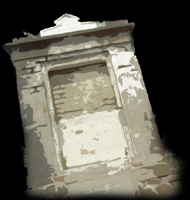
If
you
visit
the
tomb
of
Marie
Laveau
remember
this
great
Haunted
New
Orleans
Voodoo
Wish
Spell:
Knock
three
times
to
call
her
spirit.
Make
your
wish
and
turn
around
three
times
in
a
clockwise
direction
and
knock
three
times
on
the
tomb
again.
Always
leave
some
kind
of
offering
–
Marie
Laveau
is
especially
fond
of
hair
ornaments
but
anything,
from
a
coin,
a
flower,
to
a
piece
of
candy,
even
Mardi
Gras
beads,
will
do.
Also
look
near
her
tomb
for
the
most
valued
masterpiece
of
purported
ritual
hex
items,
the
Sacred
Marie
Laveau
Voodoo
Monkey
and
Cock.
These
fetishes
are
often
left
at
her
graveside
and
are
a
very
lucky
find!
Voodoo New
Orleans,
Isand of
Salvation
Botanica,
836 Piety
Street,
504-948-9961
New Orleans,
Louisiana.
Manbo Sallie
Ann Glassman
was born
in Maine
in 1954.
She is of
Jewish-Ukrainian
heritage.
Ms. Glassman
has been
practicing
Vodou in
New Orleans
since 1977.
She is the
owner of
the Island
of Salvation
Botanica,
a store
and gallery
specializing
in Vodoun
religious
supply,
medicinal
and magical
herbs, and
Haitian
and local
artworks.
She traveled
to Haiti
in November,
1995 to
undergo
the week-long
Couche initiation.
During the
initiation,
Ms. Glassman
was ordained
as Ounsi,
Kanzo and
Manbo Asogwe,
or Priestess
of Vodou,
and is one
of the few
white Americans
to have
been ordained
via the
traditional
Haitian
initiation.
Glassman
is the founder
of La Source
Ancienne
Ounfo in
New Orleans,
where she
presides
over weekly
Vodoun ceremonies.
Counted
as one of
the twenty
most active
Voodoo practitioners
in the United
States,
Priestess
Manbo Sallie
Ann Glassman
is known
for promoting
positive
thoughts
through
her Voodoo
faith. She
is also
a historian
on Voodoo
tradition
and its
roots in
Hatian Vodun.
Like many
native religions,
Vodou (often
referred
to as "Voodoo")
has been
scorned
and ridiculed
in mainstream
Judeo-Christian
communities.
"The
word 'Vodou'
sends chills
down the
spines of
most people,
and conjures
up age-old
terrors
of sorcery,
black magic,
and bogeymen
lurking
under the
bed,"
writes author
Sallie Ann
Glassman
(New Orleans
Voodoo Tarot/Book
and Card
Set). This
enticing
compendium
of the origins
and practice
of Vodou
makes for
a fascinating
read, explaining
how music,
dance, and
artistic
expression
are the
heart and
soul of
this complicated
religion.
"What
I discovered
was a vibrant,
beautiful,
and ecstatic
religion
that was
free from
dogma, guilt
or coercion,"
says Glassman,
a thoughtful
and articulate
Jewish woman
who first
began studying
New Orleans
Vodou in
1975.
Marie
Laveau's
House Of
Voodoo,
739 Bourbon
Street:
504-581-3751.
Open 10
a.m. --
11:30 p.m.,
Monday-Thursday
and Sunday;
10 a.m.
-- 1:30
a. m., Friday-Saturday
A
shop filed
with voodoo
merchandise
from around
the globe
for the
serious
practitioner
or the Novice
explorer.
Wonderful
African
and Brazilian
masks and
fetishes
for sale
as well
as Voodoo
Saints and
Catholic
Saint statues,
rosaries,
t-shirts,
incense
and voodoo
dolls and
kits and
books. If
you are
planning
on visiting
the tomb
of Marie
Laveau you
may pick
up a perfect
offering
here first-cowrie
shells,
candles
or that
special
something
that calls
you to her.
You will
want to
look at
the wonderful
displays
about voodoo—free
of charge
and view
the working
altars.
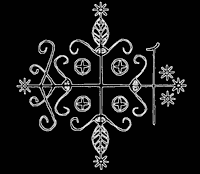
What
is
a
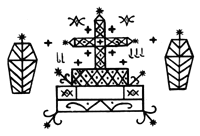
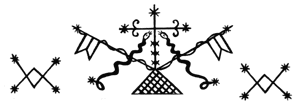
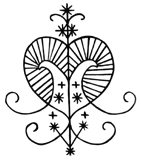
Veve'?
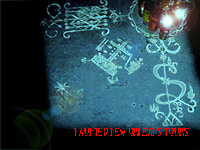
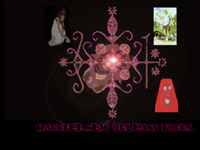
A
Veve
or
Vévé
is
a
religious
symbol
for
a
voodoo
"loa"
(or
lwa)
and
serves
as
their
representation
during
rituals.
Every
Loa
has
his
or
her
own
unique
veve,
although
regional
differences
have
led
to
different
veves
for
the
same
loa
in
a
few
cases.
Sacrifices
and
offerings
are
usually
placed
upon
them.
The
veve
is
usually
drawn
on
the
floor
by
strewing
a
powder-like
substance,
such
as
cornmeal,
wheat
flour,
bark,
red
brick
powder,
or
gunpowder.
The
material
depends
entirely
upon
the
rite.
Several
veve's
of
different
Loa
may
be
drawn
for
one
ceremony.
The
designs
incorporate
well-recognized
traditional
elements,
but
reflect
also
the
individual
intentions
and
creative
skill
of
the
Houngan
or
Mambo.
In
the United
States,
there is
strong prejudice
against
folk spirituality,
which is
freely demeaned
with pejorative
labels such
as "magic"
or "superstition".
The
versions
of Voodoo
which survivied
in the Southeastern
USA, were
connected
with Christian
mysticism
in the minds
of rural
African
Americans.
Segregation
minimized
the number
of bi-lingual
African
Americans
(those who
spoke basilect
and fluent
acrolect),
and at the
same time
minimized
the number
of Whites
who could
translate
basilect
well enough
to discover
Voodoo in
the spoken,
sung, or
written
words of
middle class,
working
class or
working-poor
African
Americans.
In isolated
African
American
communities,
such as
the Georgia
Sea Islands
or in the
Mississippi
Delta, Voodoo
lore could
be freely
referenced
and practices,
at least
the more
subtle ones,
were more
public.
In fact
many popular
songs of
the Delta
Blues tradition
(circa 1900
to 1941)
referenced
voodoo explicitly.
Robert Johnson
sang of
"hot
foot powder
sprinkled
all round
my door"
and Muddy
Water(s)
referenced
"the
gypsy woman",
"seventh
son",
and the
"mojo
hand".
Today there
are African
Americans
in integrated
Christian
congregtions
who can
recall their
parent or
Gran pointing
out the
feared Jack
o' Lantern
off in the
nighttime
woods, and
they will
insist that's
just what
they'd seen.
Scholars
debate the
variations
of Voodoo,
how they
have survived,
how much
they have
changed,
and to what
extent Christianity
in general
or Catholicism
in particular
were used
as covers
to enable
the survival
of Voodoo.
A common
saying is
that Haiti
is 80% Roman
Catholic,
20% Protestant,
and 100%
Vodou. Thus
the Catholic
contribution
to Haitian
Vodou is
quite noticeable.
However,
in the United
States the
story may
be a little
different,
depending
upon which
scholarship
you read.
Some scholars
believe
confusion
about Voodoo
in the USA
arises because
there's
widespread
system of
African
American
folk belief
and practice
known as
Hudu or
more popularly
as hoodoo.
The similarity
of the words
hoodoo and
Voodoo notwithstanding,
hoodoo may
have tenouos
connections
to organized
religion
like Vudou,
but hoodoo
may be an
integral
part of
the Vodoun
religion
in West
Africa and
arguably
throughout
all of Africa.
Some aspects
of hoodoo
may be derived
primarily
from Congo
and Angolan
practices
of Central
Africa,
and may
retain elements
of the traditions
and practices
that arose
among Bantu
language
speakers.
However,
there are
serious
practitioners
who have
travelled
and studied
Hudu in
West Africa,
who conclude
that this
ancient,
magio-botanical
practice
is indigenous
and essential
to the majority
of native
West African
religious
systems,